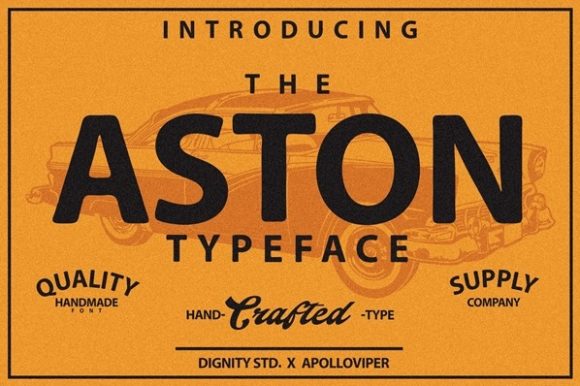
Aston Font Evaluation: A Strategic Choice for Bold Display Design
In the landscape of digital and print typography, selecting the right typeface is often a critical decision that influences the overall tone and readability of a project. Among the various options available to designers, Aston has emerged as a distinct choice for those seeking a simple, bold, and neat lettered display font. This evaluation explores the characteristics of Aston, its practical applications, and the specific scenarios where it serves as an optimal solution versus when alternative typefaces might be more appropriate.
Understanding the Characteristics of Aston
Aston is defined by its geometric precision and high-impact visual presence. As a display font, it is engineered primarily for headlines, titles, and short text blocks rather than body copy. The design philosophy behind Aston centers on simplicity; it strips away unnecessary flourishes to present a clean, modern aesthetic. The "bold" attribute refers not only to the stroke weight but also to the confidence with which the letters occupy space on the page.
The "neat" quality of the font is perhaps its most defining feature. Unlike many other display fonts that rely on organic curves or complex serifs to create interest, Aston maintains a structured grid. This results in a uniform appearance across the alphabet, ensuring that every character feels intentional and balanced. When integrated into creative ideas, this consistency allows the content itself to take center stage while the typography provides a solid, unobtrusive framework.
Why Designers Choose Aston for Creative Projects
There are several strategic reasons why professionals evaluate Aston for their upcoming projects. The primary driver is the font's ability to command attention without sacrificing legibility. In an era where users scan content rapidly, a bold display font like Aston can break up walls of text and guide the eye effectively.
- Visual Hierarchy: The strong contrast between the heavy weights of Aston and lighter body fonts creates a clear hierarchy, making navigation intuitive for the reader.
- Modern Aesthetic: The minimalist nature of the font aligns well with contemporary design trends that favor clarity and functionality over decoration.
- Versatility within Constraints: Because the lettering is neat and structured, it fits well into constrained spaces such as mobile interfaces, social media graphics, and tight print layouts.
When a designer adds Aston to their toolkit, they gain a tool that makes creative concepts stand out through sheer structural integrity. It does not shout for attention through complexity; instead, it asserts authority through form.
Benefits and Practical Applications
The benefits of using Aston extend beyond mere aesthetics. From a functional standpoint, the font's simplicity reduces cognitive load for the viewer. When reading a headline set in a highly decorative typeface, the brain must work harder to decode the shapes. With Aston, the decoding process is swift, allowing the message to be absorbed immediately.
This makes Aston particularly effective in:
- Branding and Logos: Companies looking to project stability, modernity, and directness often find success with the clean lines of Aston.
- Editorial Headlines: Magazines and online publications use it to create punchy, memorable section headers.
- Marketing Materials: Posters, banners, and flyers benefit from the font's ability to remain legible even at large sizes or from a distance.
Furthermore, the neutrality of the design means it does not clash with other graphic elements. It acts as a reliable partner to imagery, allowing photographs and illustrations to shine without competing for visual dominance.
Tradeoffs and Considerations
No typeface is without limitations, and understanding the tradeoffs of Aston is essential for making an informed decision. The primary consideration is its intended use as a display font. Using Aston for long-form body text is generally ill-advised. The heavy weight and lack of subtle variations in stroke width can cause fatigue during extended reading sessions.
Additionally, the "simple" nature of the font may be perceived as too plain for certain contexts. If a brand identity requires warmth, tradition, or a hand-crafted feel, the rigid geometry of Aston might feel cold or impersonal. Designers must weigh the desire for a clean look against the need for emotional resonance.
Another factor to consider is compatibility. While the font stands out on its own, it requires careful pairing with body text. A mismatched combination can result in a disjointed user experience. The starkness of Aston demands a companion font that complements its structure without mimicking it exactly.
Situations Where Alternatives May Be Preferred
While Aston is a strong candidate for many projects, there are specific situations where other typefaces may offer superior results. For instance, if the goal is to evoke a sense of elegance or luxury, a serif display font with fine hairlines might be a better fit. Similarly, for projects requiring a friendly or approachable tone, a rounded sans-serif or a humanist typeface could communicate the desired emotion more effectively than the geometric strictness of Aston.
Technical constraints also play a role. In web environments where performance is paramount, some display fonts can increase load times due to complex glyph sets. While Aston is relatively straightforward, designers working with extensive multilingual support should verify that the font family includes all necessary characters. If a project requires a vast array of languages, a more versatile system font might be a safer choice.
Decision-Making Insights for Selection
To determine whether Aston aligns with your specific goals, consider the following checklist before finalizing your selection:
- Define the Message: Does your content require a bold, assertive voice? If yes, Aston is likely a strong fit.
- Analyze the Layout: Are you working with large display areas or small, tight spaces? Aston excels in both, provided the scale is appropriate.
- Assess the Brand Voice: Is your brand modern and direct, or traditional and warm? Ensure the font personality matches the brand identity.
- Test Readability: Always test the font in context. View it at the intended size and resolution to ensure it remains clear and distinct.
Ultimately, the decision to use Aston should be driven by the specific needs of the communication task. It is not a universal solution, but rather a specialized tool for creating impact. By recognizing its strengths in bold display and its limitations in body text, designers can leverage its unique properties to enhance their creative output.
When evaluating typography, the goal is always to facilitate communication, not just to decorate. Aston achieves this by offering a straightforward, powerful visual language. Whether used for a website header, a book cover, or a marketing campaign, its simple, bold, and neat lettering ensures that the core message is delivered with clarity and style.